

Last updated: April 30, 2026
You ask AI to write a quick email. It spits out something decent in ten seconds. You send it. A week later, you realize you haven’t written a real email on your own in a month. You wonder if you’ve forgotten how.
That feeling is real, and you’re not alone in having it. People across every age group are quietly asking the same question: if AI keeps doing our thinking for us, are we slowly getting dumber? The honest answer is messier than a simple yes or no.
Most of what you’ll read online either panics or cheerleads. Neither one helps you make a good decision about how you actually use these tools. So let’s be straight about what’s going on.
Quick Navigation
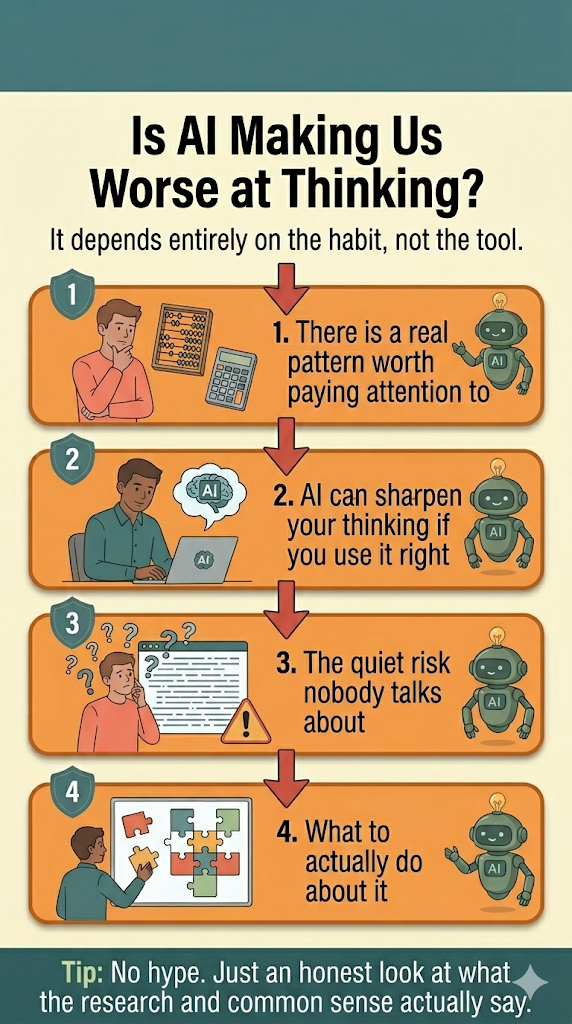
There Is a Real Pattern Worth Paying Attention To
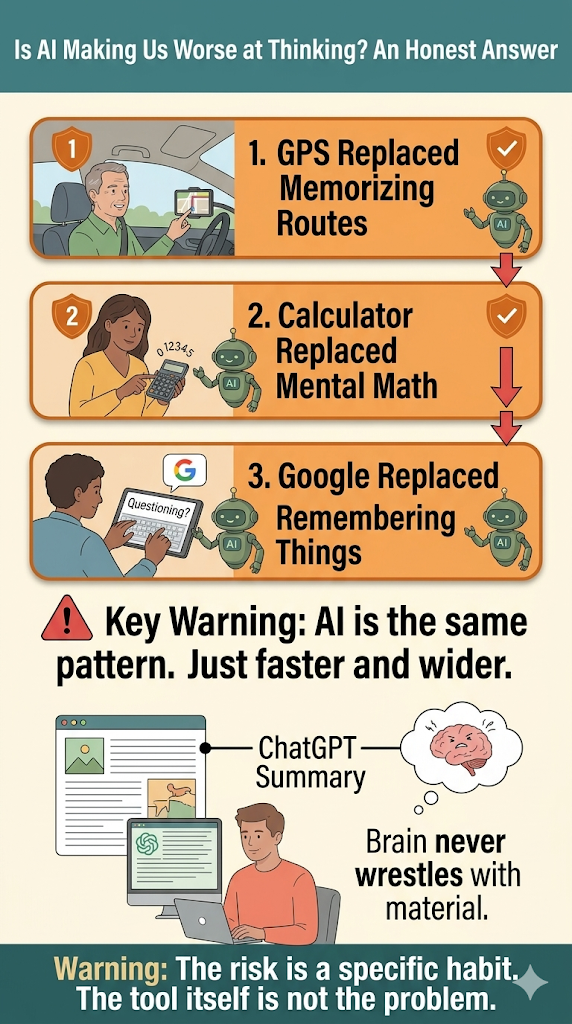
Here’s the thing: you’ve been letting tools do your thinking for you your whole life. GPS means you stopped memorizing routes. A calculator means you stopped doing mental math. Google means you stopped trying to remember things you could just look up. You handed those tasks off, and eventually, you forgot how to do them without help.
AI is the same pattern, just faster and wider. And the question has always been the same: what does it cost you?
Here’s a concrete example. If you always ask ChatGPT to summarize an article instead of reading it yourself, you skip the part where your brain wrestles with the material, forms its own connections, and actually learns something. The summary might be accurate. But the thinking didn’t happen inside you.
Over time, if you never do the wrestling, that mental muscle gets soft. That’s not a scare tactic. It’s just how brains work. Writing, problem-solving, forming your own opinion on something, those all take practice. So yes, there is a real risk here. But the risk is a specific habit, not the tool itself.
AI Can Also Sharpen Your Thinking, If You Use It That Way
The conversation usually goes wrong when people treat this as all-or-nothing, as if you’re either using AI or protecting your brain. That’s a false choice.
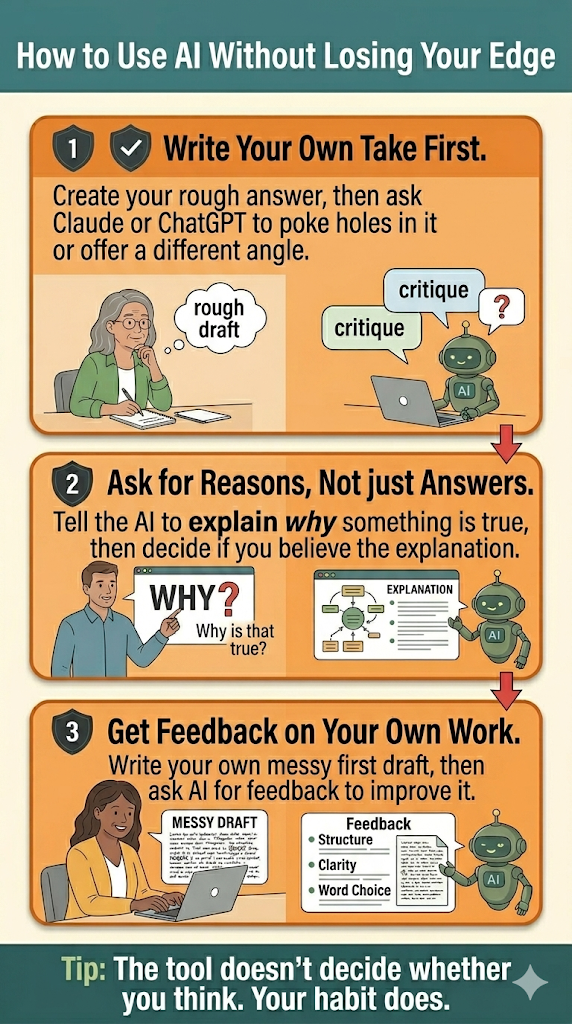
Used well, AI can push you to think harder. I do this myself. When I’m working through a problem, I’ll write out my own rough take first, then ask Claude or ChatGPT to poke holes in it or offer a different angle. That process makes me think more than I would have on my own, because now I’m comparing, questioning, and deciding whether I actually agree.
Asking AI to explain why something is true, rather than just what the answer is, and then deciding whether you actually buy that explanation, that’s active thinking. Writing your own messy first draft and then asking for feedback keeps your brain in the driver’s seat. Reading the full article yourself first, then asking what you might have missed, is a completely different experience than just asking for the summary upfront.
The tool doesn’t determine whether you think. Your habit does. And habits can be changed deliberately, which is the part people forget when they’re busy either panicking or cheering.
The Quiet Risk That Gets Talked About Less
There’s something subtler going on that I find more interesting than the “are we getting dumber” debate.
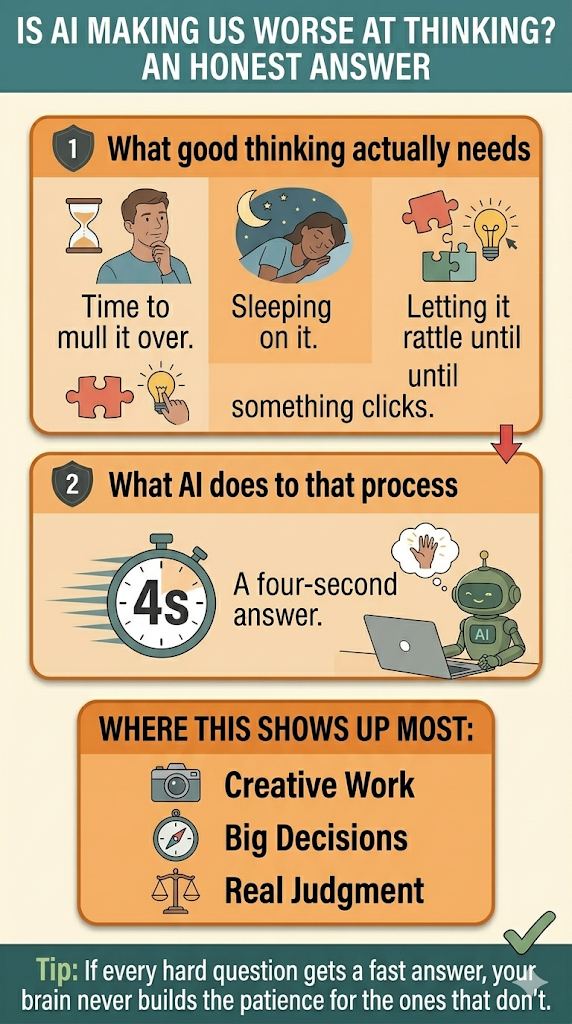
Good thinking often requires sitting with not knowing something for a while. You mull it over. You sleep on it. You let a problem rattle around until something clicks. That process is uncomfortable, and AI short-circuits it completely. You can get an answer to almost anything in about four seconds now.
The risk is that you slowly lose your tolerance for that productive discomfort. If every hard question gets a fast answer, your brain never builds the patience to work through the genuinely difficult problems, the kind that don’t have a clean answer waiting anywhere.
This shows up most in creative work, big decisions, and anything that requires real judgment. AI can give you a starting point. But the judgment still has to come from you. And if you’ve been skipping that part for a while, you might find it takes longer to get there than it used to.
Worth asking yourself honestly: when did you last sit with a hard problem for more than a few minutes before reaching for your phone?
Where This Gets Expensive If You Are Building an Online Business
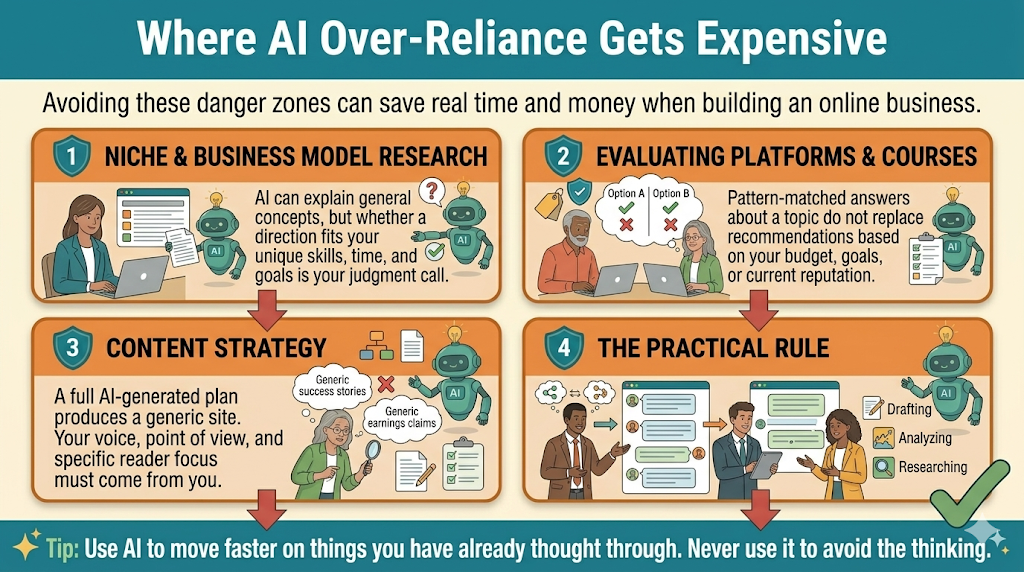
The over-reliance risk is real for anyone using AI regularly. But it has specific consequences when you are trying to build or research an online income, because the decisions you make at that stage involve real money and real time. Getting them wrong because you outsourced your thinking to a tool that cannot actually think is a costly mistake.
The most dangerous place is niche and business model research. This is the stage where you are trying to figure out whether a direction is worth pursuing before you invest months into it. AI is genuinely useful for understanding how something works in general terms. But the judgment call, is this the right fit for me, is there real demand here, does this business model make sense given my situation, that is not something AI can make for you. If you ask ChatGPT “Is affiliate marketing a good way to build income online?” and take the answer at face value without doing your own research, you are outsourcing a decision that requires your own honest assessment of your time, skills, and situation.
The second danger zone is evaluating platforms, courses, and tools. A lot of people building online end up spending money on training programs or software they did not need, partly because they asked AI whether something was worth it and got a confident-sounding answer. AI does not know your budget, your goals, your current skill level, or the current reputation of the platform you are asking about. It gives you a pattern-matched answer based on what it has seen written about that topic. That is not the same as a good recommendation.
The third area is content strategy. Using AI to generate your entire content plan without thinking it through yourself produces a content site that sounds like every other AI-generated content site. The sites that actually build an audience have a point of view, a specific reader in mind, and a voice that comes from a real person making real judgment calls. AI can help you execute a strategy. It cannot replace the thinking that makes the strategy worth executing.
The practical rule: use AI to move faster on things you have already thought through. Do not use it to avoid the thinking in the first place. The shortcut that saves you an hour of research can cost you months of working in the wrong direction.
What to Actually Do About It
I’m not going to tell you to stop using AI. That’s not realistic, and it’s not the point. These tools are genuinely useful and they’re not going away.
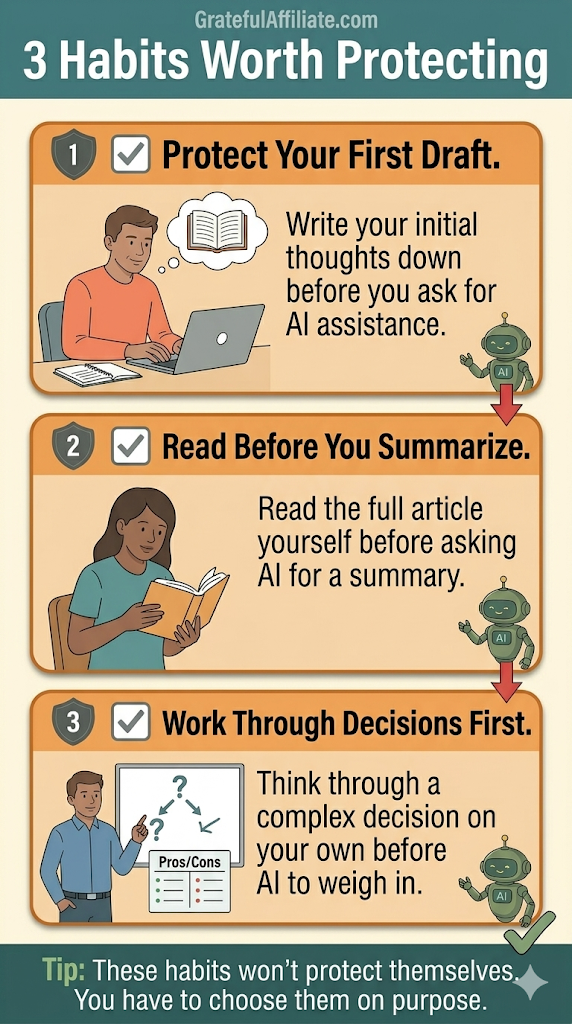
What I’d suggest instead is picking a few things you want to keep doing yourself, and protecting those habits deliberately, because they won’t protect themselves.
- Write your first draft before you ask for help.
- Read the full article before asking for a summary.
- Work through a decision on your own before asking AI to weigh in.
Whatever you choose, keep a few of those mental habits alive and practice them regularly, the same way you’d keep up any skill you actually care about.
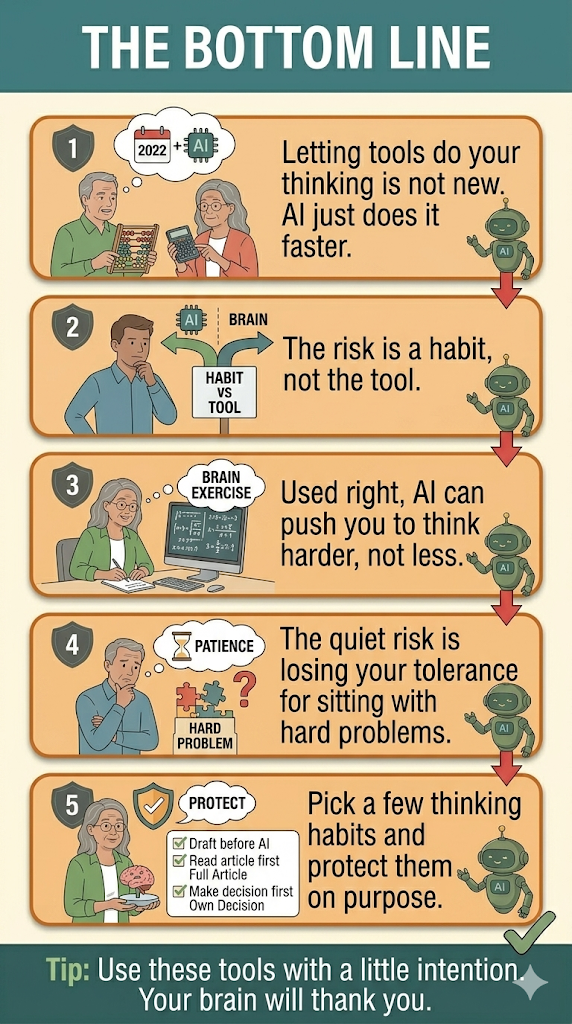
The research on long-term AI use is still pretty young. ChatGPT has only been in everyday people’s hands since late 2022, so nobody has a definitive answer yet on what years of heavy use does to how we think. But common sense and what we already know about how brains work points in the same direction: the habit matters more than the tool.
Reaching for AI before your own brain even gets a chance to try can, over time, quietly hollow out skills you actually want to keep. Stay aware of that, use these tools with a little intention, and you’ll probably be just fine.
If you want to dig into the habit side of this a bit more, a good next read is How to Use AI Without It Feeling Like Cheating, which tackles a similar question from a different angle. It also helps to know what ChatGPT is actually reliable at versus where it tends to go wrong, and 5 Things ChatGPT Is Good At and 5 Things It Is Bad At is a straight honest breakdown of exactly that. If the “are we relying on it too much” question is still on your mind, Will ChatGPT Take My Job? covers the bigger picture worry a lot of people have. And if you’ve ever wondered whether ChatGPT actually knows something or is just confidently guessing, ChatGPT Knows vs. Guessing is worth a few minutes of your time.