

Last updated: April 26, 2026
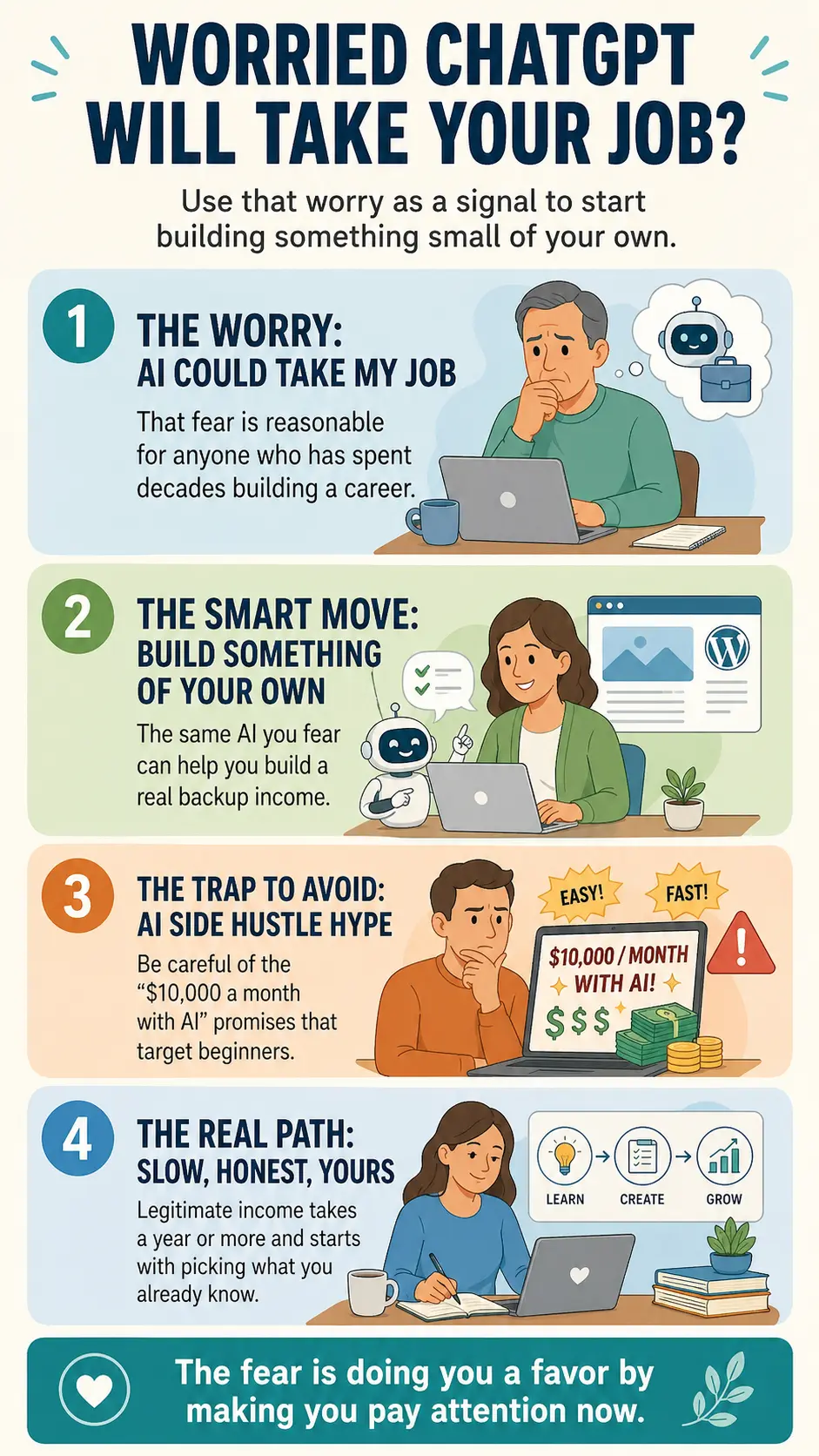
If that fear has been sitting in the back of your mind, you are not alone. Anyone who has spent 20 or 30 years building a career and watched the AI headlines for the past two years has had at least one quiet moment of “wait, am I going to be okay?”
The standard advice is to learn AI at work, get fluent with the tools, and make yourself harder to replace. That is reasonable, and you should do it. But it still leaves you betting your entire financial future on one employer’s decisions and one industry’s pace of change. That is a lot of trust to put in something you do not control.
Here is the angle worth thinking about while you still have a paycheck, energy, and time. The same AI that worries you can also help you build something small on the side that belongs to you. The “$10,000 a month with AI” promises floating around the internet are a lie, and we are not going there. I am talking about something slower and more useful: a real backup income that you actually own.
Quick Navigation
Why “Just Adapt at Work” Isn’t the Whole Answer
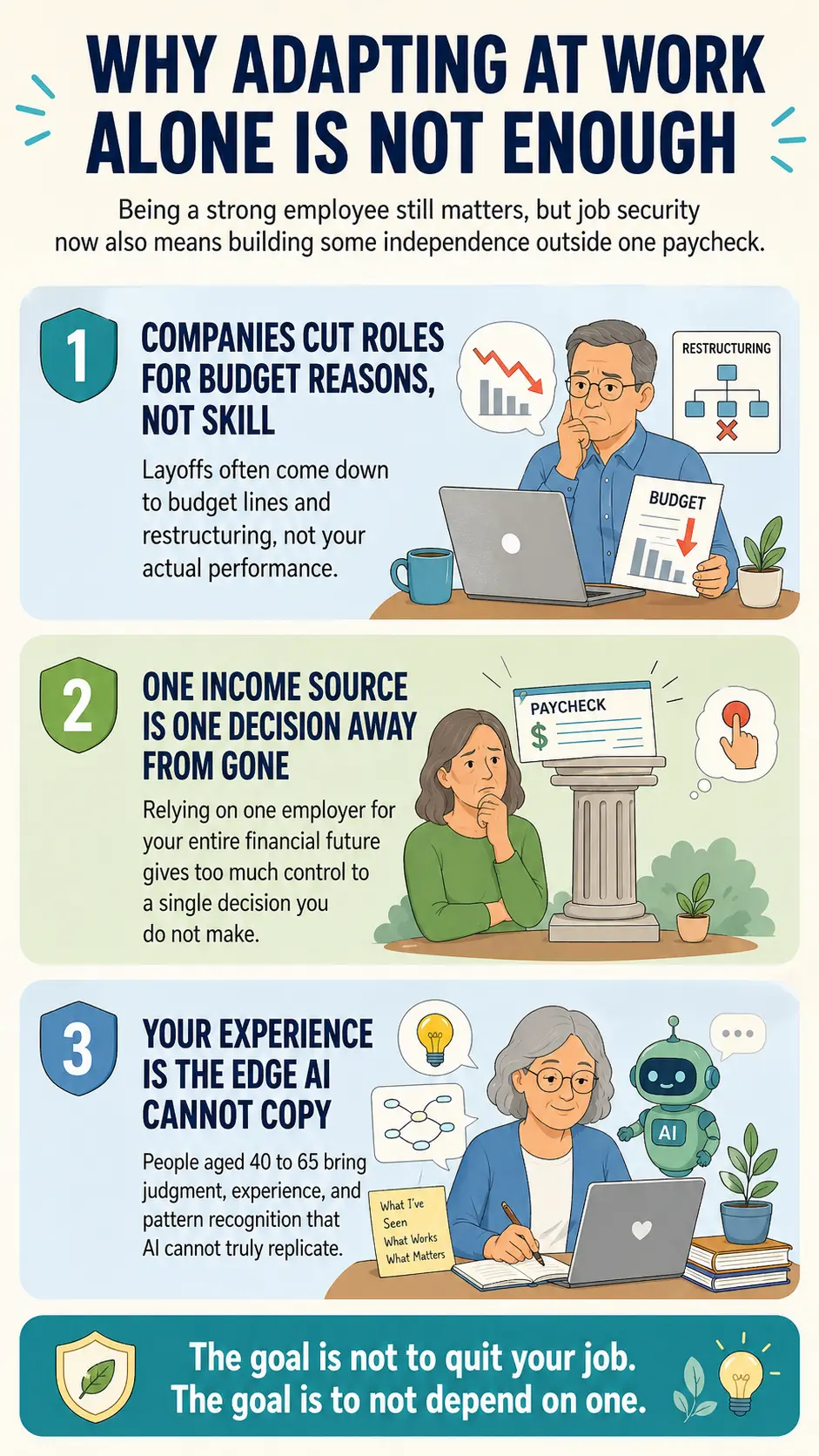
Adapting at work is good. You should do it. But it is not the whole answer.
If your role gets restructured, your team gets cut, or your company decides to consolidate three positions into one with AI handling the rest, your skills inside that company do not protect you the way you think they do. In most cases, the decision comes down to whether the budget still has a line for that role, not whether you are good at it.
That is why people in the 30 to 65 range, the ones with real skills and real judgment, are valuable at this exact moment for a reason that does not get talked about much. You can recognize when something is junk. You can spot a bad pitch from a mile away. And you have enough life experience to build something that does not depend on a manager three states away approving your continued employment.
Nobody is suggesting you quit your job. The idea is to stop relying on a single income source for your entire financial future.
What AI Can Actually Help You Build (Honestly)
Here is where I have to be straight with you, because the internet is full of people promising things AI cannot deliver.
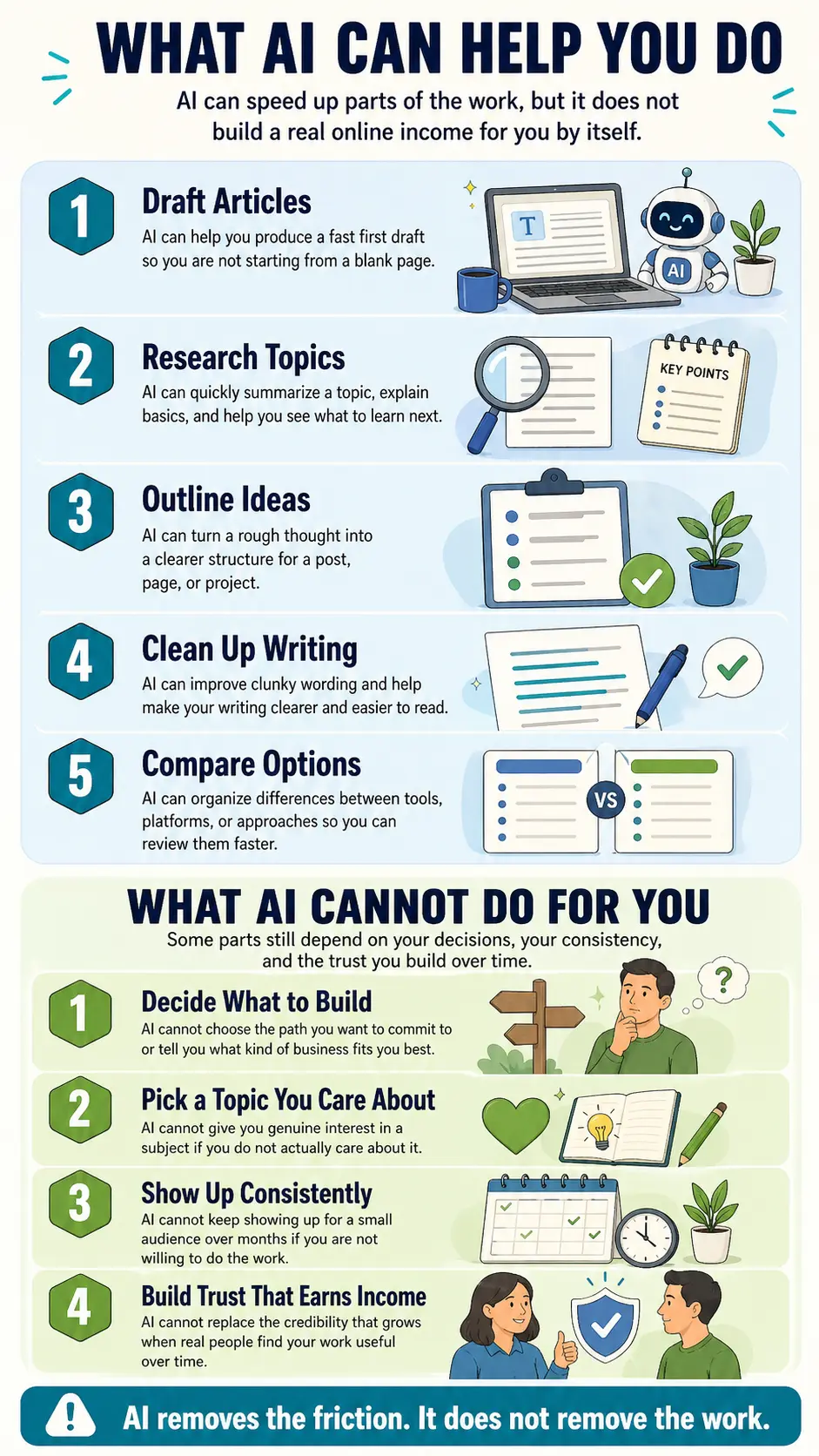
AI can speed up the parts of building something online that used to take forever, like drafting articles, researching topics, outlining ideas, cleaning up clunky writing, and comparing options. None of that used to be free or fast. Now it is both. (For a closer look at where AI shines and where it falls flat, 5 things ChatGPT is good at and 5 things it is bad at covers it in detail.)
What AI cannot do is replace you. It will not decide what to build, pick a topic you actually care about, or show up consistently for the small audience that turns into a real one. And it cannot build the trust that earns income. Judgment, consistency, and the human angle, that is still all you.
So the real picture looks like this. AI removes some of the friction that used to stop ordinary people from starting. It does not remove the work, the patience, or the need to learn. Anyone who tells you otherwise is selling something.
The AI Side Hustle Hype You Need to Walk Past
This part is not optional reading.
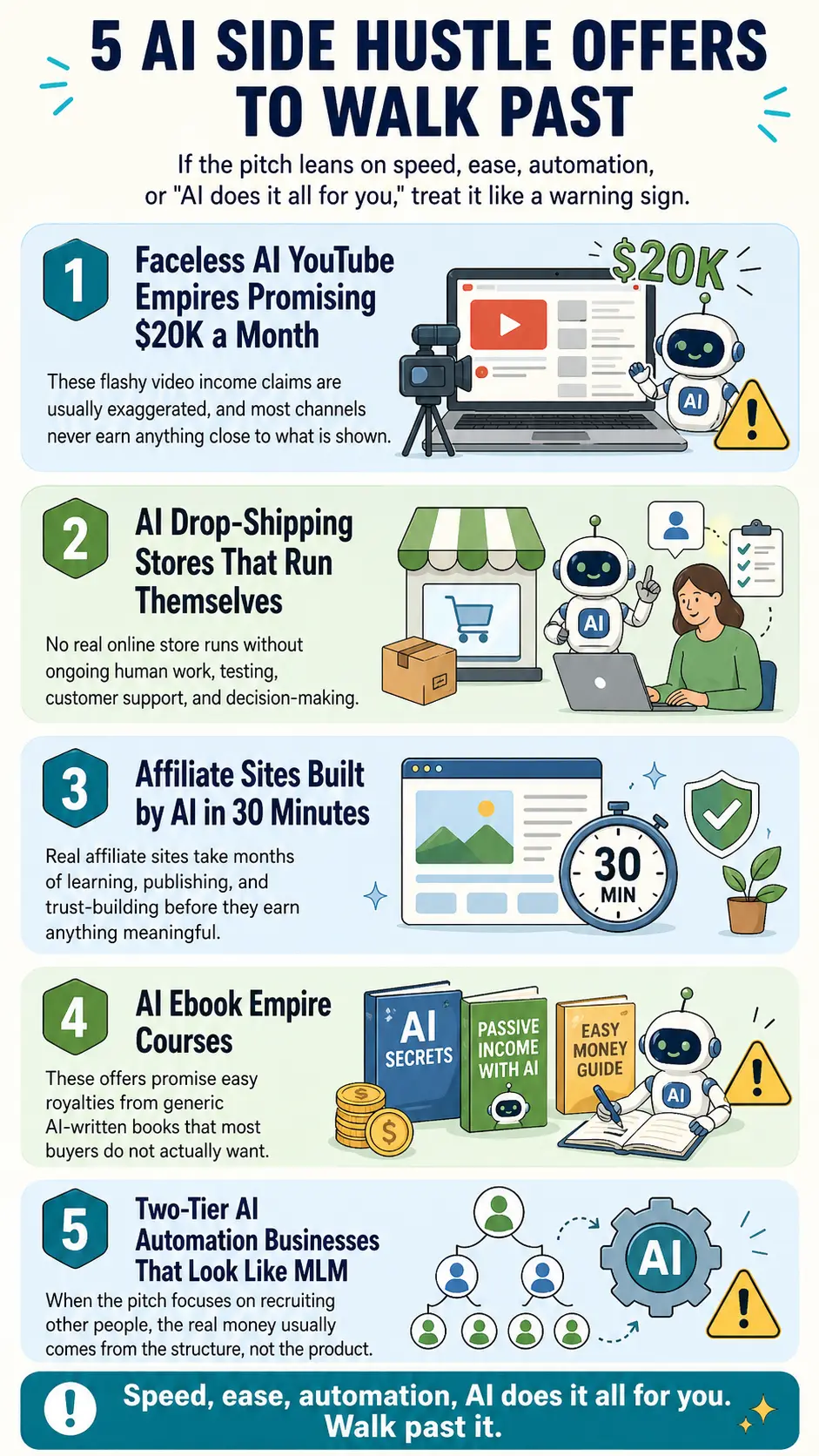
The minute you start typing “make money with AI” into a search bar, the entire internet decides you are a target. Faceless YouTube channels promising $20,000 a month from AI-generated videos. AI drop-shipping stores that “run themselves.” Affiliate sites supposedly built by AI in 30 minutes that print income on autopilot. AI ebook empires. AI automation businesses with two-tier commission structures that look suspiciously like the multi-level marketing schemes you have probably seen before.
Most of it is recycled hype dressed up in 2026 clothes. The pattern is always the same. Someone shows you a screenshot of impressive numbers. They imply anyone can do it. They sell you a course, a tool, or both. The course is overpriced. The tool is usually white-labeled software that someone else built and they slapped a name on. The income claims are either invented, cherry-picked, or come from people whose actual income comes from selling the course itself.
If the offer leans on speed, ease, automation, or “AI does it all for you,” walk past it. The legitimate path is slower, less flashy, and built on something the salesperson cannot fake: actual usefulness to actual people. How to know if it is a scam covers more warning signs to watch for.
A Realistic Starting Point For Someone Who’s Never Done This
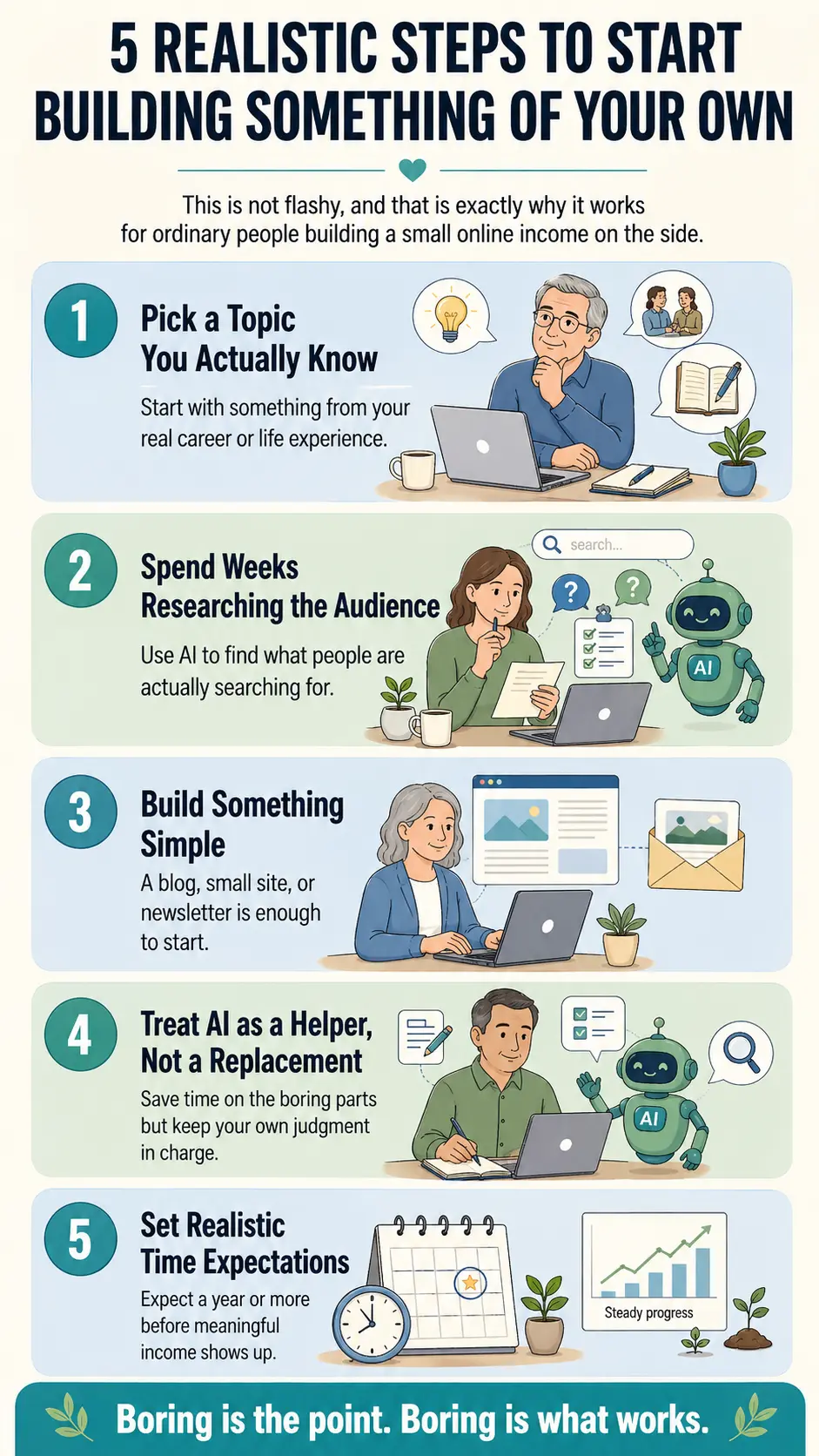
If your worry about AI replacing you is what got you reading this, the practical question is not “what should I quit.” It is “what can I quietly start while I still have a job.”
The honest version looks something like this:
- Pick something you actually know about from your career or your life. Not a niche the gurus tell you is profitable. Something where you have real opinions and can spot bad advice when you see it.
- Spend a few weeks researching whether enough people are interested in that topic and what they are searching for. AI helps a lot here. It can summarize trends, suggest related angles, and pull together questions people are actually asking.
- Build something simple. A blog, a small site, or a focused email newsletter where you publish honest, useful content and let it find a small audience over time.
- Treat AI as a helper, not a replacement for thinking. Use it to save time on the boring parts. Your judgment, your perspective, and your honest take are what people will eventually pay attention to.
- Set realistic time expectations. Most legitimate online projects take a year or more before they earn meaningful income. That timeline is just how trust works on the internet.
None of that is exciting, and none of it shows up in midnight infomercials. That is exactly why it works.
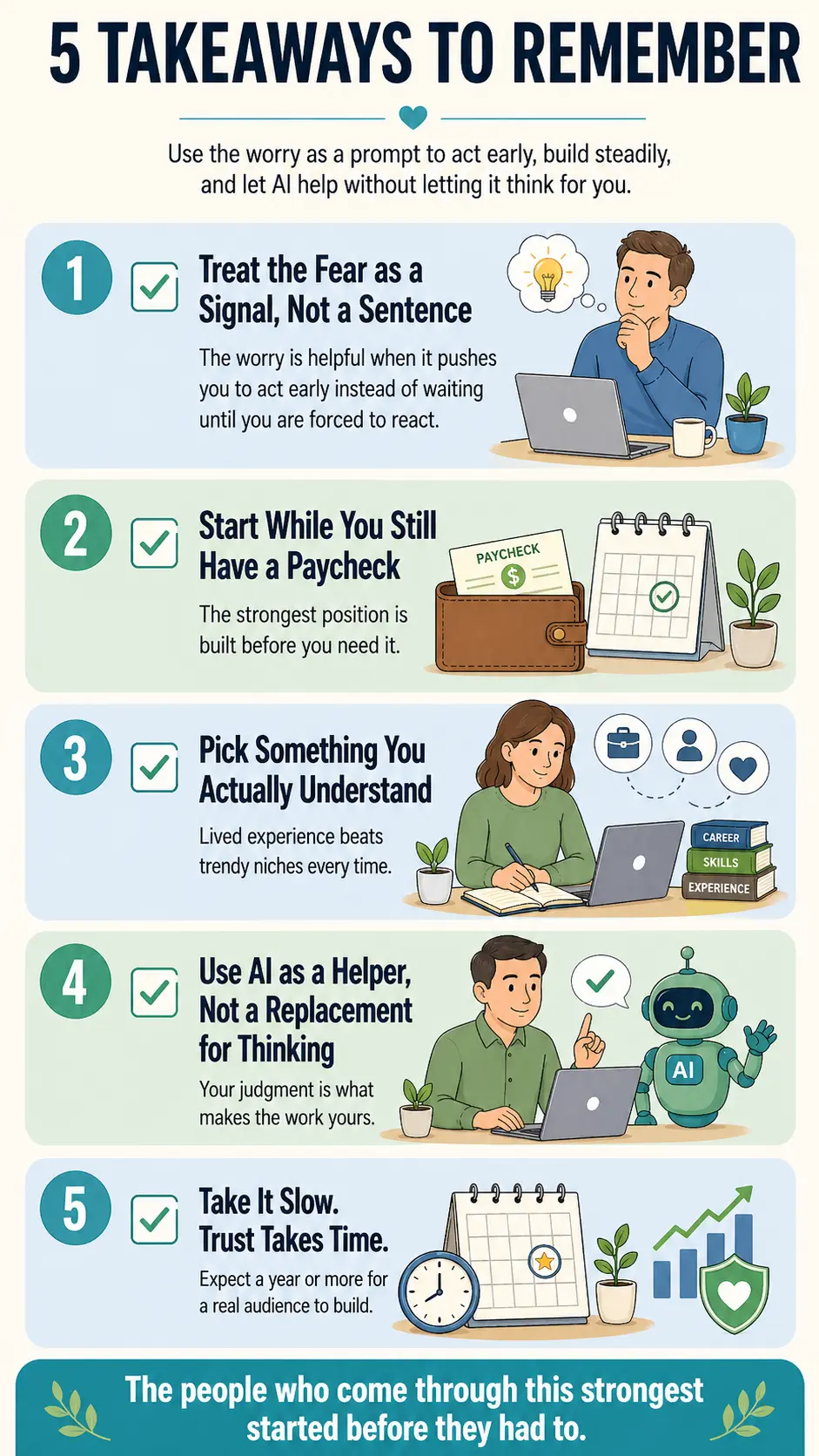
If your fear about AI taking your job is real, treat it as a useful signal. The people who come through this period in the strongest position are the ones who started building something quietly while they still had a paycheck, an income, and the time to learn at their own pace. The fear is doing you a favor by making you pay attention now, before you have to.
You have decades of experience that no chatbot has, and the judgment to tell when something is real and when it is not. Use both, take it slow, and start small. That is what actually moves the needle.
If your next question is whether to actually pay for one of these tools before you start, that is a fair one. ChatGPT free vs paid walks through it from the perspective of someone weighing real costs.
Related Reading
If you want to keep going, two related posts on this site pair well with this one. AI Tools Comparison walks through which AI tool actually fits which kind of work, so you don’t burn a week on the wrong one before you even start. Prompting Basics for ChatGPT covers how to get useful answers out of these tools once you sit down to use one. Both should save you real time if you decide the side project idea is worth a shot.