

Last updated: April 30, 2026

If you are trying to figure out whether AI could help you build something online, ChatGPT is probably the first tool people point you to. And for good reason. It is free to start, easy to use, and genuinely useful for a lot of the work that goes into running an online business.
But the way most people introduce it does not match what you actually need to know. You do not need a cheerful tour of every possible thing AI can do. You need a clear, honest picture of what ChatGPT is, what it is realistically good for, and where it falls short. That is what this guide gives you.
Quick Navigation
What ChatGPT Actually Is

ChatGPT is a text-based AI tool made by a company called OpenAI. You type something, it types back. That is the whole interface. No special skills required.
Under the hood, it works by predicting the most useful response to whatever you write, based on patterns it learned from an enormous amount of text. It is not searching the internet in real time (unless you are on a paid plan with browsing enabled). It is drawing on what it already learned during training.
That distinction matters. ChatGPT is not a search engine. It does not pull up current prices, live news, or real-time data. What it is very good at is helping you write, think through ideas, summarize information, and get plain language explanations of complicated topics. For someone researching or building an online income, those are genuinely useful things.
It is free to start at chatgpt.com. You create an account with an email address and you are in. The free version is capable enough to get a real feel for what it can do.
What It Can Realistically Help You With
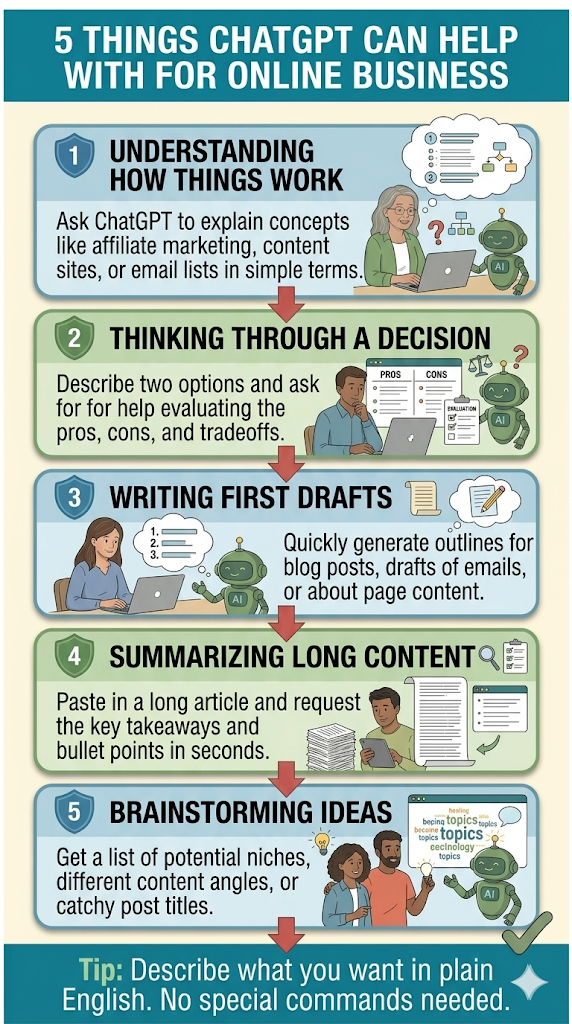
If you are at the stage of figuring out whether online business is worth pursuing, here is where ChatGPT can actually move the needle for you.
Understanding how things work. Affiliate marketing, content sites, email lists, SEO basics, digital products. If any of these terms are fuzzy, you can ask ChatGPT to explain them in plain language and follow up until it makes sense. It is patient in a way that a Google search is not.
Thinking through a decision. Considering two different approaches and not sure which fits your situation better? Describe both to ChatGPT and ask it to help you think through the tradeoffs. It will not make the decision for you, but it can help you organize your thinking.
Writing first drafts. Emails, blog post outlines, about page copy, product descriptions. ChatGPT does not write finished work for you, but it is good at getting something on the page that you can then shape. That first draft problem, the blank page, is where it genuinely saves time.
Summarizing long content. Found a 3,000-word article about a platform you are considering? Paste it in and ask for the key points. ChatGPT compresses it well.
Brainstorming ideas. Niche ideas, content angles, post titles, ways to structure something. It generates options fast. Most will be average. A few will be worth keeping.
Where It Falls Short

This part matters as much as the previous section, maybe more.
ChatGPT gets facts wrong. Not occasionally. Often enough that you should treat every specific claim it makes as “possibly true, needs checking.” It does not tell you when it is guessing. It uses the same confident tone whether it is right or wrong. For anything involving real numbers, real products, real people, or current events, verify independently before you act on it.
It does not know what is happening right now. Its training has a cutoff date. If you ask about a platform’s current pricing, a program’s recent reputation, or anything that could have changed in the last year, do not trust the answer without checking.
It cannot replace your judgment. This is the one most people underestimate. ChatGPT can generate content that sounds authoritative about a niche it knows nothing about in your specific market context. If you outsource your thinking entirely to AI, you end up with output that sounds confident but may be pointing you in the wrong direction. The tool works best when you bring your own knowledge and use AI to help you move faster, not to do the thinking for you.
And it is definitely not the “automated income machine” that some online courses sell it as. If someone is promising that ChatGPT will handle your business while you do nothing, that is not an accurate picture of how the tool works.
How to Get Started

Go to chatgpt.com and create a free account. It asks for an email address and takes about two minutes.
Once you are in, you will see a simple text box. Type your question or request the same way you would explain something to a person. You do not need special syntax or commands. Plain English works fine.
If the first answer is not quite right, say so. “Make it shorter.” “Give me a different angle.” “Explain that part again more simply.” Each follow-up sharpens the output. The back and forth is where a lot of the value is.
A few things worth trying early on, especially if you are researching online business:
- “Explain how affiliate marketing works in plain English. Assume I have never done it before.”
- “What are the main ways people build online income using content? Give me an honest overview.”
- “I am considering [specific idea]. What are the realistic pros and cons for someone just starting out?”
- “Summarize this article for me and pull out the key points.” (Then paste in something you have been meaning to read.)
None of these require any technical skill. Just describe what you want and adjust from there.
One Setting Worth Changing
By default, ChatGPT can use your conversations to train future versions of the AI. If you would rather that not happen, you can turn it off in about 30 seconds.
Click your profile icon, go to Settings, then Data Controls, and switch off “Improve the model for everyone.” It does not change how ChatGPT works for you. It just keeps your conversations out of the training pool.
Also worth knowing: do not paste passwords, account credentials, client data, or anything sensitive into ChatGPT. Treat it like any other online service. If you would not post it in a public forum, do not put it in a chat window.
The Bottom Line
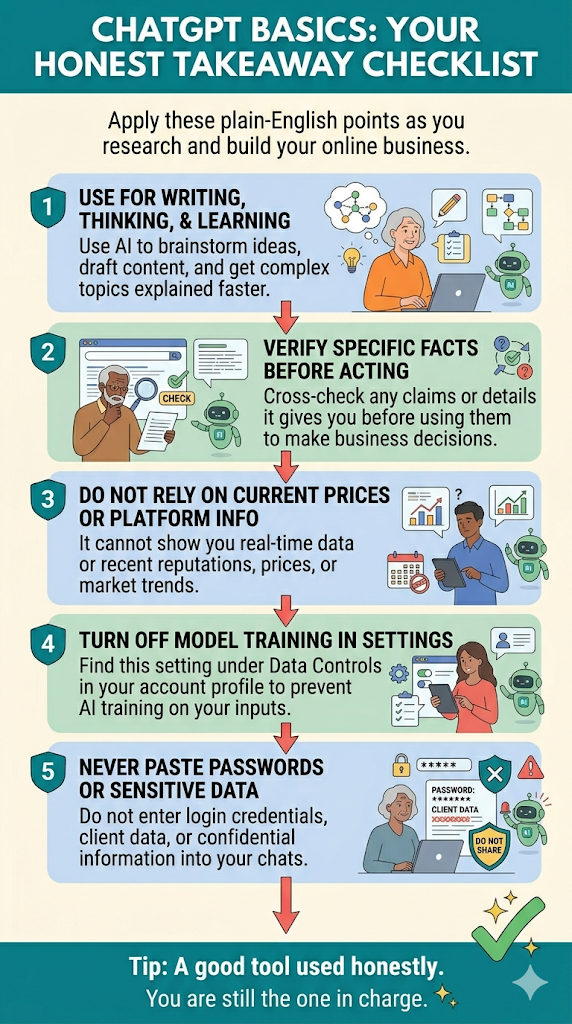
ChatGPT is a genuinely useful tool for anyone building or researching an online business. It is good at helping you write, think, and learn faster. It is not a replacement for your own judgment, it does not always get facts right, and it is not the magic automation machine it is sometimes sold as.
Used honestly and with the right expectations, it can save you real time on the repetitive parts of building something online. The key word is tool. You are still the one running the business.
If you want to go deeper on how to get better results out of it, the next guide covers prompting basics specifically for online business tasks.
Related Guides